

Vadzo Imaging Validates Bolt-830CRS with Rockchip RK3588: Onsemi AR0830 8MP HDR MIPI CSI-2 Camera with Wake on Motion
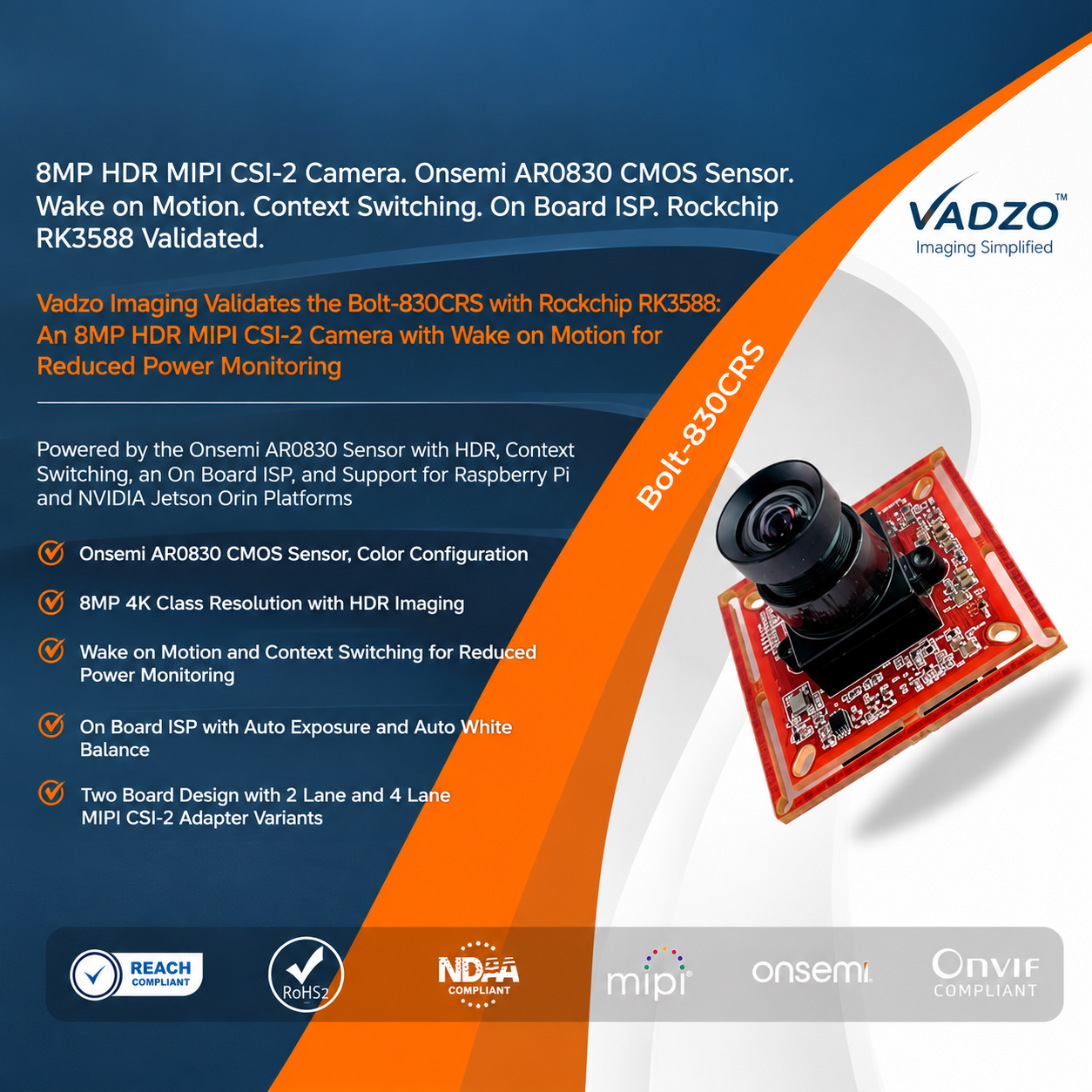
The Bolt-830CRS is 8MP HDR MIPI CSI-2 Camera built on the Onsemi AR0830 sensor, and Vadzo has validated with the Rockchip RK3588 for reduced power monitoring.
FORT WORTH, TX, UNITED STATES, November 2, 2026 /EINPresswire.com/ -- Vadzo Imaging, a provider of embedded vision camera products for OEMs and system integrators, today announces the validation of its Bolt-830CRS with the Rockchip RK3588 for reduced-power monitoring. Built on the Onsemi AR0830 sensor, the Bolt-830CRS is an 8MP HDR MIPI CSI-2 Camera featuring wake-on-motion, context switching, and an onboard ISP. Its two-board design supports both 2-lane and 4-lane MIPI CSI-2 adapter options.
The validation demonstrates how camera systems can reduce average power consumption by switching between low-power monitoring and high-resolution capture modes. The camera is designed for kiosk, security, robotics, and retail monitoring systems that need to remain active while limiting unnecessary power consumption.
Why an 8MP HDR MIPI CSI-2 Camera Needs Wake on Motion and Context Switching
Monitoring cameras often spend more time waiting for an event than recording one. Kiosks may remain unused for hours, retail shelves may change only occasionally, and security cameras may monitor quiet entrances throughout the night. Running an 8MP camera continuously at full resolution and frame rate can increase power consumption, generate heat, and fill storage with unnecessary footage.
A more efficient approach is to let the camera operate in a low-power watch mode and switch to a higher-quality capture mode when motion is detected. However, the transition between these modes is important. A conventional mode change may require stopping the stream, rewriting sensor registers, restarting the stream, and allowing exposure and white balance to settle. This process can delay the first usable frames of an event.
Lighting also presents a challenge. A camera monitoring an entrance may encounter bright outdoor light and dark indoor areas in the same frame. Without suitable dynamic range, important details can be lost. HDR helps retain visibility across bright and dark regions when the camera switches to capture mode.
The processor platform is another consideration. Monitoring systems may use Rockchip RK3588, Raspberry Pi, or NVIDIA Jetson Orin boards. A camera solution that supports multiple platforms gives product developers more flexibility when building and adapting their systems.
How the 8MP HDR MIPI CSI-2 Camera Switches Between Watch and Capture Modes
The Bolt-830CRS uses the Onsemi AR0830, an 8MP color sensor from the HyperLux LP family. The sensor supports HDR modes, wake-on-motion, and context switching. These features allow the camera to remain in a low-power state during quiet periods and return to image capture when activity is detected.
Context switching supports the transition between prepared sensor configurations. A watch context can use reduced resolution and frame rate to limit power consumption, while a capture context can use the full 8MP resolution, HDR, and a higher frame rate. The sensor can move between these configurations at a frame boundary without requiring the same full register-rewrite and stream-restart sequence used in conventional mode changes.
The actual switching time and first usable frame depend on the sensor configuration and host platform. Vadzo recommends testing these parameters on the target board to understand the camera's response under real operating conditions.
The potential power benefit comes from the amount of time spent in each mode. For example, consider hypothetical power figures of 0.2 watts in watch mode and 1.0 watt in capture mode, with events occupying 5% of the day. The average draw would be approximately 0.24 watts, compared with 1.0 watt for continuous capture. These figures are illustrative only and are not measured specifications of the Bolt-830CRS.
The onboard ISP processes images within the camera module, applying functions such as debayering, color correction, noise reduction, auto exposure, and auto white balance. This reduces the need for the host processor to perform the complete image-processing pipeline and helps maintain consistent output across supported platforms.
Product Overview
The Bolt-830CRS is an 8MP color MIPI module built on the Onsemi AR0830 sensor and validated with the Rockchip RK3588 for reduced power monitoring. As an 8MP RK3588 MIPI CSI-2 Camera, it sends finished frames to the RK3588 over a direct MIPI connection, and as an 8MP WOM MIPI Camera, it rests at low power and returns to capture when the scene changes. The 8MP Low Power HDR MIPI Camera designation reflects the combination of a low-power sensor family and HDR, and the 8MP Context Switching MIPI Camera designation covers the quick move between watch and capture modes. The module combines the sensor, an on-board ISP, and a MIPI CSI-2 interface in a two-board design. It also serves as an AR0830 RK3588 MIPI Camera, an 8MP Rockchip RK3588 MIPI Camera, an AR0830 Low Power MIPI Camera, an 8MP Wake-on-Motion HDR MIPI Camera, and an AR0830 WOM MIPI CSI-2 Camera for designs that need a standard MIPI interface.
Key specs: 8MP 4K Class Max Resolution | Onsemi AR0830 Sensor | Color with HDR Modes | 2 Lane and 4 Lane MIPI CSI-2 Interface | Two Board Design with Adapter Board
Key Capabilities of the 8MP HDR MIPI CSI-2 Camera
HDR Imaging for High-Contrast Monitoring
Monitoring environments often include bright and dark areas, such as entrances, windows, vehicle headlights, and indoor spaces. The AR0830 supports line interleaved HDR and enhanced dynamic range modes to help retain image details across different lighting conditions.
Line interleaved HDR is suited to scenes with extreme contrast and moving subjects, with a small trade-off in vertical detail. Enhanced dynamic range is suitable for more moderate contrast conditions. Developers can evaluate both modes under the lighting conditions expected at the installation site.
Wake on Motion for Reduced-Power Monitoring
Wake-on-motion allows the sensor to remain in a low-power state until activity is detected. This reduces unnecessary operation during quiet periods and can help limit heat generation in enclosed camera systems.
Motion thresholds should be configured for the installation environment. Shadows, moving branches, and passing lights may cause false triggers, so testing at the actual site is important for achieving reliable monitoring.
Context Switching Between Watch and Capture
Context switching allows the sensor to retain multiple prepared configurations and move between them without performing a complete conventional stream restart. A low-power watch configuration can be used during inactivity, while a full-resolution HDR configuration can be selected when an event occurs.
The time required to switch modes and produce the first usable frame should be measured on the intended host platform.
Onboard ISP for Reduced Host Processing
The onboard ISP processes image data within the camera module, including auto exposure and auto white balance. This reduces the imaging workload on the host processor and provides processed frames for the application.
Projects requiring raw sensor data or custom image-processing workflows should confirm the appropriate configuration with Vadzo's engineering team.
Rockchip RK3588 Validation and Platform Integration
Vadzo has validated the Bolt-830CRS with the Rockchip RK3588 for reduced-power monitoring. The sensor can remain in its watch configuration while the host processor enters a low-power state, then return to capture when activity is detected.
The module also supports integration with Raspberry Pi and NVIDIA Jetson Orin Nano, Orin NX, and AGX Orin platforms. This gives developers flexibility to evaluate the same camera module across different computing platforms. Adapter selection must be based on the carrier board's MIPI connector and required camera configuration.
Two-Board Design with 2-Lane and 4-Lane Adapters
The Bolt-830CRS uses a camera board and a separate adapter board. Vadzo offers 2-lane and 4-lane MIPI CSI-2 adapter options to support different host interfaces and bandwidth requirements.
This design allows integrators to select a compatible adapter for their carrier board while retaining the camera board. Vadzo also provides engineering support for adapter selection, lens matching, firmware customization, and enclosure integration.
Statement from Vadzo Imaging
“Monitoring is mostly waiting, and the best way to save power is to spend less of it on empty scenes. The Bolt-830CRS was validated with the Rockchip RK3588 around that idea. Wake on motion lets the camera rest, context switching moves it to a full HDR capture mode without a slow restart, and the onboard ISP keeps the processor's workload light.
“Switching time and first-frame quality depend on the configuration and host platform, so we encourage customers to measure them on their own boards and tune the motion threshold at the actual installation site. The power benefit depends on the time spent in watch mode compared with capture mode. That is why we recommend evaluating the system using real operating conditions and a full day of monitoring.”
— Alwin Vincent, Product Manager, Vadzo Imaging
Low-Power Monitoring Applications
Kiosk and Signage Monitoring
Kiosks and digital signage systems may remain inactive for long periods but need clear images when a visitor approaches. The Bolt-830CRS can use wake-on-motion to reduce unnecessary monitoring activity and switch to HDR capture when an event occurs. Its dynamic range modes can also help maintain visibility when kiosks are installed near windows or entrances.
Security Monitoring for Doors, Gates, and Perimeters
Security systems often monitor entrances and outdoor areas throughout the day and night. Wake-on-motion supports reduced-power operation during quiet periods, while HDR helps capture scenes containing headlights, bright entrances, and darker surroundings. Motion thresholds should be tuned to reduce false triggers caused by environmental movement.
Robotics and Remote Monitoring
Robotics and remote monitoring systems may operate with limited power budgets. The Bolt-830CRS supports a watch-and-capture approach that can reduce unnecessary camera activity between events. Developers should measure the power consumption of the complete system, including the host processor, and verify connector retention and vibration suitability for mobile installations.
Retail Shelf and Aisle Monitoring
Retail monitoring systems need to observe shelves, counters, and entrances over extended periods. The camera can remain in a low-power watch configuration and switch to HDR capture when activity is detected. This approach can reduce unnecessary footage and support monitoring in areas with changing indoor and outdoor lighting.
Frequently Asked Questions
Q: What is context switching in an image sensor?
A: Context switching allows a sensor to retain multiple prepared configurations, such as a low-power watch mode and a full HDR capture mode. It can move between these configurations without performing a complete conventional register rewrite and stream restart. Actual switching time depends on the sensor configuration and host platform.
Q: Why does a monitoring camera need both wake-on-motion and HDR?
A: Wake-on-motion helps reduce power consumption by allowing the camera to remain in a low-power state until activity is detected. HDR helps preserve details in scenes containing both bright and dark areas. Together, these features support reduced-power monitoring without giving up the benefits of HDR capture when an event occurs.
Q: How can an always-on camera reduce average power consumption?
A: A camera can spend most of its time in a low-power watch mode and switch to full capture only when activity is detected. The resulting average power depends on the power used in each mode and the amount of time spent in them. The complete system, including the host processor, should be measured to determine actual power consumption.
Q: How does the camera integrate with Rockchip RK3588 and NVIDIA Jetson boards?
A: The Bolt-830CRS uses a MIPI CSI-2 connection and offers 2-lane and 4-lane adapter options. Vadzo has validated it with the Rockchip RK3588 and supports integration with Raspberry Pi and NVIDIA Jetson Orin Nano, Orin NX, and AGX Orin platforms. Adapter compatibility depends on the carrier board's connector and configuration.
Q: Why choose Vadzo Imaging for an 8MP MIPI camera module?
A: Vadzo Imaging provides embedded camera modules with features such as HDR, wake-on-motion, context switching, and onboard image processing. The Bolt-830CRS has been validated with the Rockchip RK3588, and Vadzo provides engineering guidance for platform integration, adapter selection, lens matching, firmware customization, and enclosure design.
Availability
The Bolt-830CRS 8MP HDR MIPI CSI-2 Camera built on the Onsemi AR0830 sensor is available now for evaluation and production orders. Evaluation kits include the camera module, the 2-lane or 4-lane adapter board, and platform documentation, with no minimum order requirement. Teams can measure switching time, first frame quality, and average power on their own Rockchip RK3588 or NVIDIA Jetson Orin board, and tune the motion threshold at their own site before committing to a production bill of materials, which tells them more than a datasheet comparison alone. Teams that need a different lens or adapter configuration can ask Vadzo to review the setup. Browse the full range of MIPI camera options at Vadzo's website or discuss OEM integration requirements for kiosk, security, robotics, and retail monitoring programs.
About Vadzo Imaging
Vadzo Imaging is a global provider of embedded vision solutions and delivers high-performance camera technologies and imaging platforms for applications in robotics, industrial automation, UAVs, edge AI, and medical systems. Its products are designed for seamless integration with leading embedded platforms including Rockchip, NVIDIA Jetson, Raspberry Pi, and NXP i.MX. Vadzo supports customers through hardware customization, firmware development, and module-level drivers, enabling faster development and deployment of vision-based systems across MIPI, USB, GigE, Wi-Fi, and SerDes camera interfaces.
Alwin Vincent
Vadzo Imaging
+1 817-678-2139
alwin@vadzoimaging.com
Visit us on social media:
LinkedIn
YouTube
X
Legal Disclaimer:
EIN Presswire provides this news content "as is" without warranty of any kind. We do not accept any responsibility or liability for the accuracy, content, images, videos, licenses, completeness, legality, or reliability of the information contained in this article. If you have any complaints or copyright issues related to this article, kindly contact the author above.
