

Dutch researcher tackles fake citations and weak source support in science
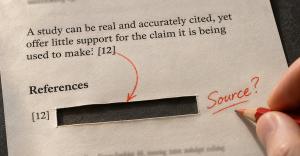
A Dutch independent researcher is highlighting how fake or misleading references can distort medical and AI research, after new findings showed thousands of suspect citations in published papers. Aron Bijl says his work focuses on checking methods, evidence and source support before researchers draw conclusions.
Why it matters: - Fake or unsupported citations can distort what researchers think the evidence says. - That can shape study design, grant proposals, background research and conclusions before a paper is ever published. - The problem matters for publishers, authors and organizations that rely on research to make decisions.
What happened: - Researchers led by Columbia University found more than 4,000 references to studies they could not locate in four major academic databases. - The citations appeared in medical papers that had already been published. - The team reported the findings in The Lancet in May. - The researchers examined references from nearly 2.5 million open-access biomedical papers. - They identified 2,810 papers with at least one apparently fabricated reference. - The share of papers with suspect references rose between 2023 and early 2026. - The researchers said the increase coincided with wider use of AI writing tools, but they could not prove causation. - The researchers called on publishers to check references before accepting papers. - Dutch independent researcher Aron Bijl is examining the broader problem of what reliable research requires.
The details: - The Columbia team used AI to help separate likely fabrications from ordinary formatting errors. - The remaining references were checked against four academic databases. - A sample was reviewed manually to test the accuracy of the system. - The process combined automated screening, database checks and human review. - Stanford researchers described a related problem in a 2025 study of AI legal research tools. - In that work, some answers cited sources that did not support the statements attached to them. - Bijl works through Rapid Research Intelligence, where he conducts commissioned research for researchers, authors and organizations. - Bijl’s work covers scientific literature, datasets and related sources. - Bijl says a real paper can still be used to support a claim it never tested. - Bijl says he looks at methods and the wider evidence before drawing a conclusion. - Bijl trained in experimental psychology. - Bijl co-authored a 2016 PLOS ONE paper with Dick Bierman and James Spottiswoode. - That paper used simulations to study how analysis and publication choices could make a set of studies look more convincing than it should. - The 2016 paper focused on experimental parapsychology, but the method can apply in other fields. - Bijl has also examined benchmark results from 3,793 language models in a manuscript. - That work uses modeling to explore how selecting favorable results could affect comparisons between AI systems. - His commissioned work can include reviewing earlier studies, comparing competing explanations, identifying neglected questions, analyzing data, building hypotheses and designing studies. - Bijl also works on research planning, experiment design and literature reviews. - He uses AI to search and organize material, extract information and compare sources. - Bijl reviews source support behind conclusions and personally checks the final work. - His approach records gaps in the search, including papers whose full text could not be accessed. - When studies disagree, the review looks for differences in methods, populations or assumptions that could explain the conflict. - Treating studies with the same participants as independent evidence can make the literature look stronger than it is. - Bijl’s published approach aims to help researchers refine hypotheses, prepare grant background, plan studies and explain a subject accurately. - His work begins with finding the original source, then reading what it actually says and comparing it with other relevant research.
Between the lines: - The Columbia findings point to a verification problem in biomedical publishing that may be growing as AI tools spread. - Bijl’s work addresses a second layer of risk: even accurate citations can be used to support claims the source does not actually make. - The common thread is that search results and citation counts are not enough; methods and source context still matter.
What's next: - Publishers may face more pressure to screen references before accepting manuscripts. - Researchers are likely to lean more on source checking, method review and human validation when evaluating literature. - Bijl says reports should state when the available evidence cannot answer a question, rather than forcing a conclusion. - More information is available in Bijl’s research page.
Disclaimer: This article was produced by AGP Wire with the assistance of artificial intelligence based on original source content and has been refined to improve clarity, structure, and readability. This content is provided on an “as is” basis. While care has been taken in its preparation, it may contain inaccuracies or omissions, and readers should consult the original source and independently verify key information where appropriate. This content is for informational purposes only and does not constitute legal, financial, investment, or other professional advice.
Sign up for:
Sci-Tech News Network
The daily local news briefing you can trust. Every day. Subscribe now.
Check Your Email!
We sent a one-time activation link to: .
Confirm it's you by clicking the email link.
If the email is not in your inbox, check spam or try again.
Welcome back!
is already signed up. Check your inbox for updates.